13 April 2009

Mexico: Part 2: Puebla


After our arrival in Puebla and a quick lunch we set out to Cholula.  


Cholula is known for having the largest pyramidal base in the world. Apparently the Spanish did not know this pyramid existed, they thought the hill would make a great location for a church.


During our tour of the site I noticed a few employees cleaning the site, I wondered, could I help? After we had finished exploring the archeological remains we walked up to the church: Santuario de la Virgen de los Remedios. From this viewpoint I counted six other churches in close proximity. I jokingly asked a friend how much sin could possibly exist in this small town. 


The next day myself and some fellow travelers walked around Puebla. We toured two other churches. One of the cathedrals has a 60 meter tower, however, to our disappointment the tower was closed. I'm not sure what this building is/used for but, for a second I felt like I was in Greece, the blue and white building reminded me of landscapes I've seen. Hmm, when will I make a visit to Greece?

A visit to a candy shop was another stop. Surprisingly I didn't sample any chocolate. I was waiting for some tortillas filled with meat and cheese from Taco Tony's- mmm.

04 April 2009

Mexico: Part 1: Mexico City

On the 27th of march I arrived in Mexico City. Due to lack of sleep, (about 30 hours), I didn´t do anything upon my arrival. I entered my hotel room, showered, and only left to grab something to eat at a 7-11.

The next morning I was well rested and began to explore the city. After walking through Parque Alameda I continued on to Constitution Plaza. While photographing the plaza I was stopped by a young girl and her mother. The girl had an assignment; to ask a native English speaker a few questions. Simple questions were asked such as "where do you live", "do you like to travel", "do you like Mexico". I hope she received a good grade. I then walked over to Templo Mayor. A lot of this site has been destroyed or built on. The museum had a good collection of artifacts and excavation is still ongoing.


Later that evening I met with my tour leader and group. We had a delicious dinner and upon returning to the hotel I met my roommate, Sylvie from Switzerland.

The next morning a few of us went to Teotihuacan. We first stopped at the Plaza de las Tres Culturas. A Combination of Aztec, Spanish and Mexican cultures. 


After touring the artists shop and sampling some Mezcal we finally began exploring Teotihuacan. An expansive site indeed. I had time to climb the Pyramid of the Sun, taller than the Pyramid of the Moon. So much to see and being a Sunday (Mexicans don't pay admission on Sundays) the place was extremely crowded. 


We stopped for lunch at none other than Teotihuacan Restaurant. Another great meal and entertainment was provided by two guitarists and two dancers.


We were driven over to the Basilica de Nuestra Senora de Guadalupe. We viewed the temple from afar, toured the old basilica (lots of scalfolding), and the modern basilica. This place has now become the most visited site in the entire world. A shawl with the image of the Virgin of Guadalupe brings millions of people to Mexico City every year. 

The current church was built in the 1970s and can hold 40,000 worshipers. I think the modern basilica is absolutely hideous, what an eyesore! 

26 March 2009

Peru: Part 6: The Jungle and Lima (last day in Peru)

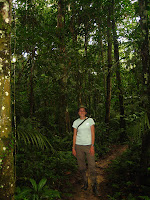
From Cusco we flew to Puerto Maldonado. After a quick stop we boarded a canoe to begin our journey upstream to the jungle lodge. We arrived at the lodge at 6:30pm, already dark but we had our flashlights ready. The lodge exceeded expectations. The place is well maintained- very clean. Although the showers only have cold water there are flush toilets and the sleeping quarters are built up off of the ground (no jungle critters greeting you in the morning). Soon after our arrival a large, excellent buffet was ready. With such a long day of travel the night ended early and I retired to my bed, complete with mosquito netting.


Our activities were delayed in the morning due to a down pour (imagine that, rain in the rainforest). But soon enough the weather cleared and we paid a visit to a farm across the river. We tried a few different fruits grown on the land, some were very sour. At the farm we were able to see a few monkeys hanging and swinging from the trees. Crops are usually lower in numbers due to the monkeys and other animals taking their share.

Our jungle excursion was slick and muddy. Not much wildlife was seen, just a small snake, cutter ants and some sort of weasel. We heard the sound of wild pigs, followed the noise for a little while but never saw them. Early the next morning we bid farewell to the jungle and made our return trip to Puerto Maldonado and then back to Lima.

 
I spent my last day in Peru visiting the site of Pachacamac and the Museum of Gold. Pachacamac is an expansive site but lies in ruins. Unfortunately some of the site has seen development, and not legally. A family builds a home, others follow suit, a whole town springs up quickly and the government doesn't do much about it because of the cost and the strength of the new town. There are a few things about Peru I don't understand, this and the lack of taxes are two things. 

The museum of gold has a large collection of artifacts from numerous cultures of Peru. A few skulls I saw I thought were victims of trepanation but instead these skulls were worn around the waist of a warrior to show his prowess. 

Before I left for the airport I had my last meal in Peru at Bembo's- the Peruvian McDonald's. The food at Bembo's is better.

My adventures in Peru were fantastic! Traveling with great people and a fun, friendly guide always helps. 

Next up: Mexico and Central America!

Peru: Part 5: Cusco

We spent two days before the Inca Trail and one day after touring the city of  Cusco. During a tour of the city we walked around two plazas, and spent some time at a small museum exhibiting the works of Hilario Mendivil. A famous landmark of the city is the twelve angle stone of an ancient Inca temple. The Peurvian beer, Cusquena, has this stone engraved on the bottles. 


We also toured six archeological sites near Cusco; Pisac, Ollantaytambo, Tambomach'ay, Pukapukara, Q'Engo and Saqsayhuaman. All sites varied in size and the degree in which they remain intact.  

Saqsayhuaman provided a great deal of entertainment due to its name. When pronounced Saqsayhuaman sounds a lot like Sexy Woman. Many photos were taken of sexy poses. Here's my attempt: 


We stopped by a coca shop to try various products made from the plant; tea, brownies, cookies and chocolates. Everything was delicious and I bought a few treats for myself. Cynthia gave us a brief history on the plant and informed us, despite the rumors and the uninformed, the plant in its natural form is not a drug. The only thing I became addicted to during my tour of Peru was the country itself. 

I also stopped by a large handicraft market. I didn't buy much, just two t-shirts. A lot of the products being sold I had seen throughout my travels. I toured Santo Domingo Church, built by the Spanish and on top of an Inca Temple. A small museum located near the church housed a minimal amount of artifacts but did display skulls containing trepination marks and deformities from skull binding. Before I returned to the hotel to met up for dinner I stopped by the Popular Art Museum. Another small museum that contained a few pieces from Mendivil and other art works made from such things as silverware and guinea pig bones. 

23 March 2009

Peru: Part 4: The Inca Trail

Shortly after arriving to the first check point of the trail in Ollantaytambo I heard "AnnMarie, AnnMarie". Turns out Jia Min, from the Ecuador trip, was making the trek as well. What a small world it is!

After being cleared we crossed a swing bridge and began our hike. The trail began easy enough- flat terrain, but eventually there were some steep ascents and long gradual climbs. I was surprised by how many homes, small villages are located along the trail. I had expected to leave civilization behind as soon as the trail began. Villagers were selling snacks and drinks during this portion of the trail but I had packed enough food in my day pack to keep me well fed.

I arrived at our first campsite around 6pm. Everything was set up; the tents, dining area, etc. The porters clapped as each one of us entered the campsite, they did this throughout the trip- great encouragement. During the trail these porters carried everything for us and would RUN past us. They hike the trail about 4-5 times a month and are in great shape. Our trail guide told us some people have ran the trail in less than three hours, not bad for a 28 mile course with steep climbs.

Day two of the trail was the longest and hardest day. Steep ascents and descents occurred with greater frequency. I welcomed the arrival of DeadWoman's Pass, the highest point of the trail at 4200m(13779 ft). We took a long break as I shared some Pringles with the group. The chips then acted as motivation for the rest of the day. Did I stumble upon a new ad campaign for the makers of Pringles?

We toured two sites during the days trek, Runkuracay and Sayacmarca. After touring the second site it was only another half hour walk (flat terrain) to our next campsite- Chaquicocha. After another delicious dinner (the food served was first rate quality), much needed rest was in order.

Our third day was a shorter and easier hike but the trail still had its moments. In the morning we toured the site of Phuyupatamarca - "town of the clouds".  By 1pm we arrived at our campsite- Winay Wayna. A restaurant and shower facilities were located at this camping area. A shower, even a lukewarm one was great relief after three days of treking. It felt great to be clean! After some free time we toured the site of Winay Wayna- "forever young". After dinner there was a short ceremony to celebrate our journey and give thanks to the porters. The porters sang a song in their native language- Quechua. Since most of the travel group is Australian, they sang Waltzing Matilda. I got a pass from singing because I said our thanks in Spanish. The night ended early due to our wake up call at 3:45am the next morning.

Day 4: MACHU PICCHU!

Here it is. Well worth the strenuous 3+ days of hiking and quite the wonder indeed.
We toured the site for a few hours. I was in awe the whole time. WOW!- that's my comment on Machu Picchu and the experience. If you have the desire and the drive- hike the trail- you won't be disappointed.


Peru: Part 3: Lake Titicaca; Floating Island Visit, Homestay at Llachon Island and Taquille Island

At the port of Puno we bought some gifts for our next homestay visit. We set sail on Lake Titicaca to first visit the floating reed island of Titino. A resident showed us how the island is formed and how at any moment the island could be cut up if people were no longer getting along. A volleyball game and a ride around the island on their reed boat were also part of the visit.


We then sailed on to Llachon Island. My "dad" Joaquin quickly introduced me to my "family". He and his wife have four children; ages 11, 9, 5 and 3. I played games with the kids until I noticed lunch was being prepared. I offered to help and was given the duty of washing the dishes. I had another opportunity to practice Spanish, knowing some of the language definitely has come in handy, especially with these homestays.


During our visit we also had the opportuity to pick potatoes for dinner, play volleyball and soccer with the community. For our dinner all of us were given the local attire to wear. 

The next morning after a hearty breakfast I gave my gifts to the family; some needed food items and gifts for the kids. Roy, the 5 year old walked with us down to the pier to say goodbye. I had a wonderful, fun time with the kids and enjoyed this visit immensely.


Our next destination was Taquille Island. We walked around the island for 45 minutes taking a short rest with a view of Soto Island- the deepest section of the lake. During our excursion countless children asked us to buy their bracelets. These kids should be in school but parents have them earn money instead of learning, so we were told not to buy anything- giving them money does nothing for the situation. After a delicious lunch we returned to our boat and set sail for Puno.